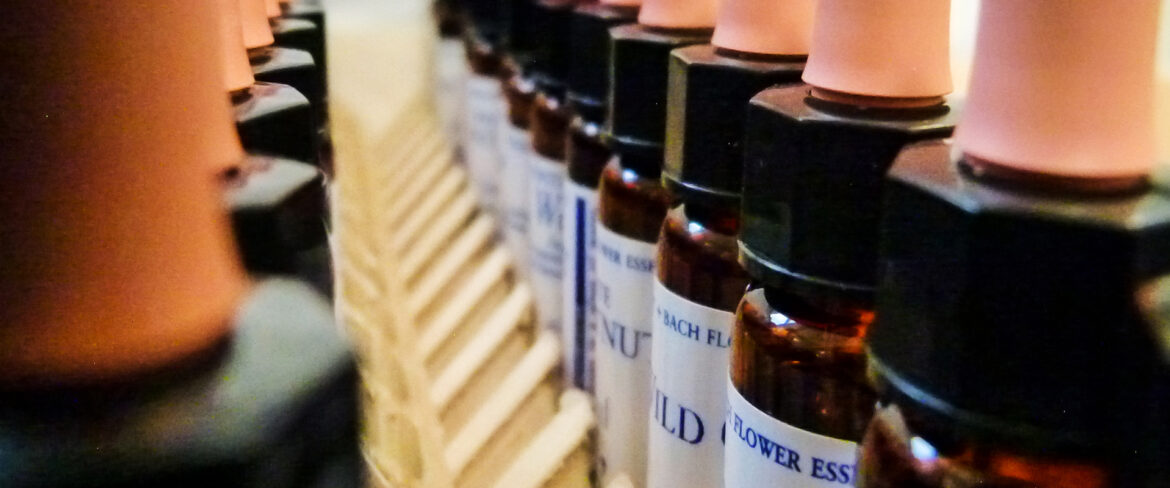
Flower essences have been in use throughout the world since the 1930’s
There are now an abundance of essences made from a wide variety of substances, but the original set consists of 38 essences of flowers mainly native to the British Isles.
Today essences are made from various sources, but they are best known as originating from flowers, which is not surprising as flowers have been used in various therapeutic and mood enhancing activities throughout the ages. The concept of employing a flower’s energy for improving wellbeing, although less recognised, is also ancient in origin and thought to have been practised by early cultures from the Egyptians to Aborigines. Herbalist also traditionally held sprigs of flowers under running water and used the resulting liquid in treatments. In 16th century Europe, Paracelsus and other alchemists are known to have collected drops of liquid from plants, such as Lady’s Mantle, that mysteriously appeared overnight on the edges of their leaves. Indeed, Lady’s Mantle is named Alchemilla mollis after the interest it provoked in these early chemists, in their search for the elixir of life.
During the early twentieth century, Dr Edward Bach (1886-1936) re-discovered flower essences and created the Bach Flower Remedies. He recognised the link between emotions and illness and developed essences to support the whole person rather than just their physical symptoms.
In Heal Thyself, he wrote “. . . disease is . . . the result of a conflict between soul and mind and will never be eradicated except by spiritual and mental effort.”
Since the Bach Remedies were first introduced, many new essences have been developed to reflect the challenges of modern life and our increased understanding of the various factors that can affect well-being.
Vibrational essences are liquid solutions made of the energetic imprint of flowers, plants, trees, crystals, and other natural sources. They are most often taken orally and have a therapeutic effect on our personalities – supporting, strengthening, and empowering us so we are able to function at our optimum level. They awaken, resolve, and transform our emotional/mental attitudes or inner disharmony, enhancing our well-being on many levels.
Using vibrational essences is a growing and transformational modality that offers so much potential to support us in our modern world. Essences are safe for children, animals, the unwell, and the elderly, and are very versatile in their use.
There is a distinct lack of published scientific research in this therapy and evidence mainly centres on the testimony of thousands of witnesses who have benefited from their use.
Naturally, the essence world would like to see the therapy more widely accepted and used, but we have little technology available for monitoring efficacy that is based on a holistic model of a human, where physical health is seen as part of a larger picture that includes their emotions, mental state, lifestyle and aspirations. Additionally, a practice in which an individual’s emotional and mental state is taken into consideration and where ten clients with the same symptom may be given ten completely different treatments, does not lend itself to double blind studies. Neither is current research designed to take into account any growth in consciousness or change in feelings which can occur when taking essences.
Research using Kirlian photography or other aura photography can compare the ‘before’ and ‘after’ effects of taking an essence. Yet until there is mainstream acceptance of the importance of the subtle anatomy and its significance in health, this would be insufficient proof for those working in traditional health fields that essences can facilitate significant changes to a person’s wellbeing.
One of the first qualitative pieces of research, using the Bach Flower Remedies, was carried out in 1976 by Brian Forbes, a consultant who ran the Bristol Cancer Clinic. Here he discovered that essences really helped patients cope with the challenges created by their treatment and condition. More recently, Michael Hyland, Professor of Health Psychology at Plymouth University used the Green Man Essences (see Focus Fixes TUTS 1 at www.greenmanshop.co.uk) for a quantitative experiment which proved, statistically, that this essence reduced the incidence and intensity of tantrums in children between two and five years old.
There have additionally been several scientific studies carried out on essences in countries like Russia over the past few decades, but it has not been deemed advantageous to make information about these studies available to the public. Hopefully this research will be disclosed in the years to come, and many new studies undertaken.
Currently, the BFVEA is involved in a long-term research project to explore the efficacy of essences. The tool used by their practitioners to evaluate client progress is known as MYMOP (Measure Yourself Medical Outcome Profile), where clients numerically assess how they feel before and after taking essences. This provides immediate feedback as to whether the treatment has helped their problems or not and has proved a useful tool in a therapy where the aim is to make clients simply feel ‘normal’ and ‘themselves’ again. BFVEA research so far indicates that essences not only make a positive difference to clients, but that this change is statistically significant at the 1% level.
Read the research written up in 2017.
To find out more about MYMOP please click on the following link www.bris.ac.uk/primaryhealthcare/resources/mymop
If you would like to view the MYMOP video – What it is, How to use it and What is a good MYMOP, please click on the following link youtube.com/watch
From bfvea.com and healingherbs.co.uk